Sunday, March 10, 2013

Farewell, Winter!

From Julie H., historical interpreter:

As winter fades away, and the snow steadily melts, we leave behind our winter hours and trudge forward into the costumed season tomorrow (March 11th). We've been quite busy this past winter on many projects. We got a lot of woodworking done, we re-built some old fences, made sausage from our pigs for the upcoming season, and did a ton of sewing.

Kathleen, an intern, helps mix sausage:
Here's just a small portion of the brand new shirts and shifts we cranked out:
And of course, we already posted on the baby animals born in this time, and our new horses that have just arrived. So I'll leave you with some winter pictures of the past few months, in case you couldn't get here to see the beautiful scenery yourself.

So we are now BACK IN COSTUME! Come by and see us!

Saturday, March 9, 2013

Percherons

From Stacie H., horse handler & interpreter:

Chip and Mike are Percheron Draft Horse, they are 7 years. They are going to be an addition to the museum to help make deliveries to the different farms. The Percheron breed originated from France. They were originally bred for war use. The average weight of the breed is 1,900 to 2,600 pounds, and the average height of this breed 16.2 and 17.3 hands tall (one hand is four inches).  Make sure you come say hi!

Above is Chip and Mike checking out their new feeders.
 Look at the size compared to the barn!
 Catching up on my sun bathing...

We'll post some photos this year of them in action. There are many fields to plow!

Tuesday, March 5, 2013

This little piggy...

From Julie H., historical interpreter:

Wow. We were just nearly ready to post all about the new Percheron horses, when we discovered these little fellows today! Now, counting baby piglets is almost like counting chickens before they hatch, so keep your fingers crossed that these guys will all survive! They move quickly, so it was hard to get a clear shot.

These are Ossabaw Island Razorback pigs. They were brought over by the Spanish in the 1500s to the coast of Georgia, and became the English settlers' hog of choice in early Virginia.


Readers, you should definitely come visit and see all the new baby animals, and the horses too. But if you plan to come Wednesday or even Thursday this week (March 6-7), call before you come! We're in the center of this mega snow storm, and we may be closed.

Wednesday, February 27, 2013

New FCM Family Members

From Julie H., historical interpreter:

Hi all! It's been a little quiet here on the blog lately. Our staff has been busy during our winter hours with many projects, like sausage making, fence building, and mass amounts of sewing of new garments for the upcoming costumed season. We're excited for the upcoming year, and there'll be a lot of posts in the near future on more farm & daily life activities. I'll have a few winter-themed posts up shortly, now that the bulk of the sewing is finished, but before we get into that, there are some exciting announcements!

Our dear Hallie, an English Red Devon, gave birth today!!! We haven't named the little heifer (female) yet, but we'll think of some good 1630s-appropriate names soon. We were expecting Hallie to have her little one next month, so we were quite pleased to see the wee thing this morning. Come by and meet her, she's so adorable!
Hallie's half-sister, Lottie, will be giving birth in about a month or two, so stay tuned for another birth announcement!


Also, for those of you who made it out to our Christmas Lantern Tours programs, you met some beautiful horses who pulled the wagons to the New World. We are so fortunate to welcome two Percherons more permanently to the museum, and their owner, one of our new staffers, will be working them regularly. I'll have more about Chip and Mike here in a few days, but here's a teaser photo of these handsome fellows:

Also, coming up, after the horses, we'll post photos from a beautiful snow fall from the other week, finish Part II of English Christmas Baking, and maybe even learn all about the recent thatching job on our Irish blacksmith shop. Check back soon, we'll be updating frequently again!

Saturday, January 12, 2013

English Christmas Baking - PART 1 - Making the coffin

From Sally L., historical interpreter:

Even though it's now January, we want to show some of the projects we did in December on the farms. We get so busy with our Christmas Lantern Tours and all our other programs, so we are glad to finally share these with you!

On our 1630s English farm, we are demonstrating Christmas baking. We are making mincemeat pyes to be cooked in the bake oven. We used to interpret the 1690s on the farm, and we just recently switched to an earlier time period, so we are still in the process of changing things over to the 1630s. This is the method we've used for the past many years. We combine 3 receipts- two from The Accomplisht Cook, by Robert May, first written in 1685, and one from The English Housewife, by Gervase Markham, first written in 1615.

Mincemeat pyes are key to the Christmas celebration. It was an English custom to try to eat twelve pieces of mincemeat pye from twelve different pyes to insure good luck for the next twelve months of the year. Christmas bake day is especially a hub of activity. The goodwife (lady of the house), daughters, and servants would be bustling about preparing mincemeat pyes, plum pudding, and making a very large quantity of wassail. We made all of these, but we will discuss the latter ones at a later time! Today, two staff members, one adult volunteer, and three jr. interpreters are all helping with the Christmas baking of the mincemeat pyes.

These are the three receipts we combined to make the mincemeat pyes.
Below, is our mix of beef, currants, raisins, candied lemon peel, suet, and then all the spices you cannot see- cloves, mace, nutmeg, salt, pepper and caraway seed.
Next, rye flour and whole wheat flour are mixed together. These two flours will help make the pastry container, called a coffin, very strong.
 Now, we add plain hot water, and additional hot water containing melted lard into the flour mixture.  
Here is a close up of coffin mixture as we stir it, and me mixing the two flours, the water, and the lardy water together to make a malleable dough.
After it forms a nice dough that isn't crumbly, we roll out the coffin mixture. The ideal crust should be at least 1/4 " thick. 
Rebecca is using a plate as a template to trace around to make the bottom of the coffin an even circle
Here we are making the walls, again rolling the dough about a 1/4" thick, and then using the rolling pin as a template for the height of the side pieces.  
 Now it's Kayla's turn to try...
Make sure you wet the bottom of the coffin where you plan to attach the sides. Water acts as the "glue" for attaching the pieces together.
 
We pick up the sides and attach them to the base of the coffin. Pinch/bend a little of the side in, and then attach it to the base where the "glue" is.
 More bending and attaching.....
A close up of the coffin.
 Two coffins under construction......
We are all hard at work!
We put a tab on the coffin side. We did this to reinforce where two side pieces connect. This really helps the coffin to hold the meat mixture inside and not leak!
 Rebecca with her completed coffin and ready for the next step!
Kayla and Sally putting finishing touches on another coffin.
Now, the coffins are ready to be filled. Join me next time, and check back soon for Part II- filling up and covering the coffins, and baking the pyes! Until then!

Wednesday, November 21, 2012

Pumpkin Pie!

From Julie H., historical interpreter:

Autumn- what a fantastic season! In addition to beautiful changing leaves, autumn conjures up mouth-watering mental images of delicious foods. Sweet potatoes. Squash. Turkey. Apple cider. And of course, pumpkin! For those of you also in the ever-growing pinterest world, you've been tempted with thousands of pictures of autumn-themed recipes. Well, here's a recipe that you will definitely want to bookmark for this holiday season- pumpkin pie!

There are two things to know about our 1820s recipe for pumpkin pie. The first is that historically, they would've called it a "receipt" and not a "recipe." The second is that they called it a pudding in a crust, and not a pie.

While they did have pie back then, a pudding stirs up a whole different style of cooking. Historical puddings can be make in a number of ways, and can be both sweet and savory. Technically, haggis (yes, that haggis) is a pudding. Many are boiled in bags, called pudding cloths, though, as with haggis, they can also be boiled in a stomach casing. In the early 19th century, receipts for puddings often referred to baked puddings, and typically mixed the main ingredients with a handful of eggs to create a custard-style dish. Many of the recipes called for the pudding to be placed in a puff paste- essentially, a bottom pie crust. This particular receipt is interesting, because it also calls for a crust treatment on the top, too.
This is from Mary Randolph's "Virginia Housewife," the 1824 version, which was the first edition published. We'll walk you through it, and help translate the hearth cooking version as we've done to your modern ovens. We'll show you how to make the puff paste (pie crust) receipt, but feel free to use your own favorite homemade or store bought pie crust! But do yourself a favor, and buy an actual pumpkin, not the canned stuff.

PUMPKIN PUDDING (modern ingredient list)
-1 small/medium sized pumpkin
-4-5 eggs
-half a pint of milk
-quarter pound of butter
-pinches of ginger and nutmeg
-approx. 1/2 cup brandy (optional)
-sugar (to taste, so anywhere from a 1/4 cup to 2 cups!)

We begin with cutting up the pumpkin, and removing the goo and the seeds. Save the seeds for roasting!
Cut the pumpkin in to strips, and then into chunks. Peel off the outside, with either a knife or peeler.
Once you have all your chunks in a pot, add some water to keep it from burning on the bottom, and place it over the fire in a slow boil to soften the pumpkin. For those doing this at home, put your stove about medium high to bring it to a nice boil.
With that settled, you can begin to make the pie crust, or, in our time period, the puff paste. If you'd like to use a pre-made crust at home to save time, go for it, or if you have your own favorite modern crust you like to make, go for it too! Puff pastes aren't known for being really tasty. But if you want to do the historic crust, here's the method, according to Mary Randolph.

Randolph says to sift out a quart of flour, leaving some out for rolling later. Instead of a quart, we measured out about a quarter pound of flour for the bottom crust, with our awesome scale, and then a little less for the top crust.
Randolph next says to add cold water to the flour, "knead it well" into a "stiff paste." If you're doing this at home, you will unfortunately have to eyeball it. My suggestion is to pour a small amount of water in, say, a quarter of a cup, and mix it together, then add very small amounts of water as you need to get the right consistency. A "stiff paste" should look and feel like... pie crust!
Once you have your stiff paste, set aside a chunk about 1/3 the paste, and roll out the rest. Randolph says to wash the salt from a pound of butter (or, just go buy unsalted butter, because, we can do that in the 21st century!), divide the butter into parts, and then begin rolling the butter in to the paste to mix it in.
Once the butter is nicely "mingled" with the paste, place it into a baking dish, and cut the excess off. Make sure there are no pockets of air in the edges of the dish.
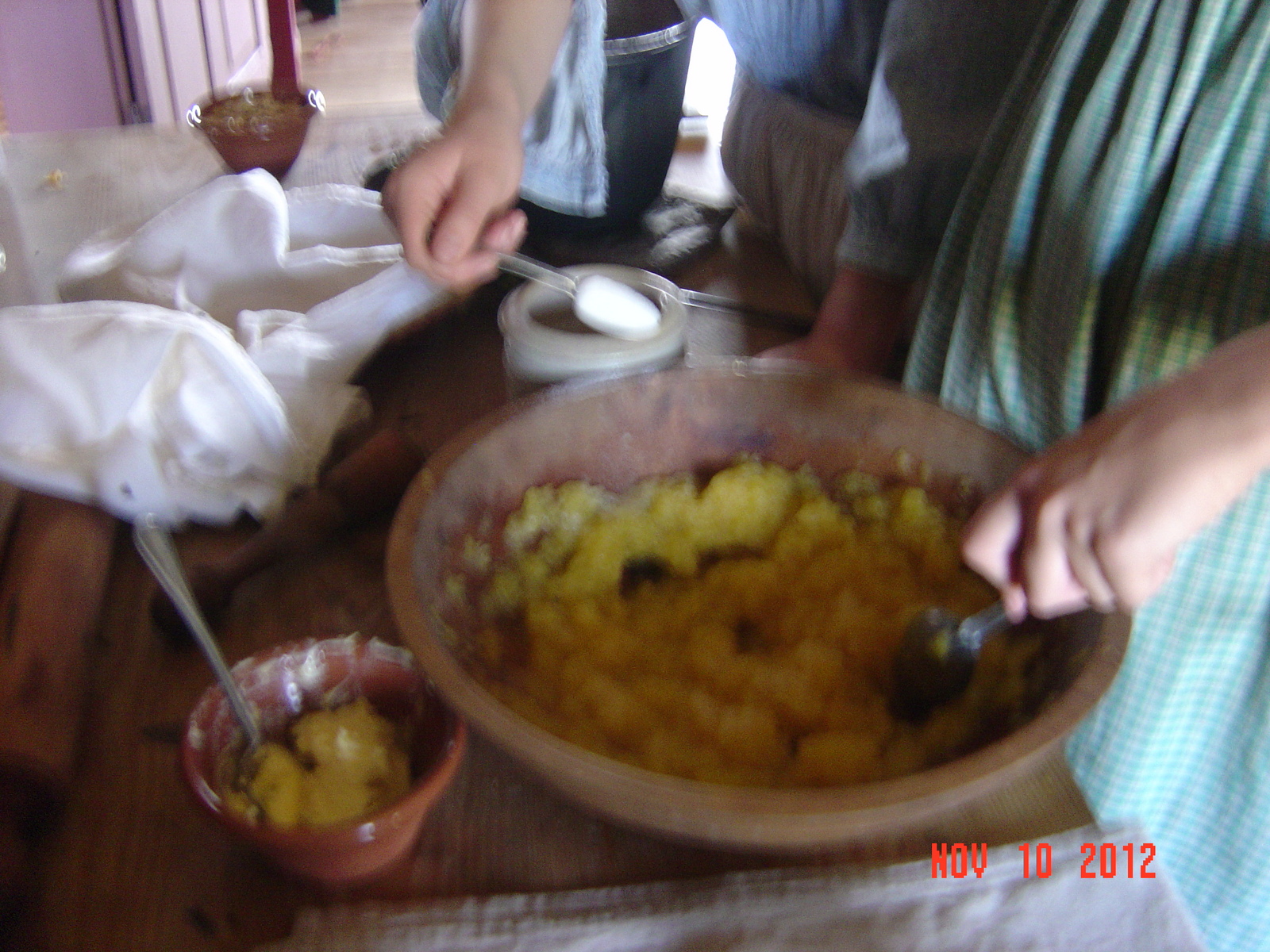
Now that the bottom crust is ready to go, if your pumpkin hasn't stewed enough, use the same method to finish the top crust. We'll show you that shortly, but let's get that stewed pumpkin! The first thing you'll want to do is strain the pumpkin, either through a sieve or cheesecloth, to get smoother pulp. If you have neither, I suppose you could quickly drop the mix into a food processor for a few seconds, or push it through a spaghetti strainer (disclaimer: I've never done that, so I have no clue if it would work or not! Proceed at your own risk!).

Once nice and smooth, here is where you'll need those other ingredients. Now, Randolph's receipt says to use 6 eggs, but we suggest 4-5 instead, especially if you're getting store-bought eggs. Modern chickens have been genetically engineered to be MASSIVE birds that lay MASSIVE eggs, much bigger than most birds and eggs in the early 19th century. So, it is a good idea to use a few less eggs. Add your eggs to the pumpkin, along with your milk, butter, ginger, nutmeg, sugar, and, if you'd like, brandy (put in a little less milk in this case). You don't want it too liquidy. Randolph suggests to stew the mix a little if it is too liquidy.

Unfortunately, in our excitement for the nearly-finished pie, the next set of pictures turned out a little blurry. We apologize for this, but you can imagine just how good it was starting to smell!
One of our German farm staffers stops by to observe and beg for a taste. If this happens in your kitchen at home, I would suggest fending the German off with a wooden spoon.
Add the mixture to your puff paste/pie crust.
Here's the interesting part. Randolph writes, "cut some thin bits of paste, twist them and lay them across the top." Now, historically, there really isn't much precedent for lattice topped pies, but this is pretty close, and the exact execution of this is open to interpretation. How many strips? How close to one another? In both directions? Who knows. And frankly, you are master of your own kitchen, so do whatever the heck you want!
It's a little blurry, sorry!
But, blurry or not, George the Cat approves.
Place the pie in the oven to bake. We used the dutch oven, placing hot coals under it and on top of the thick lid. We checked it after half an hour of baking, and finally pulled it out after 45 minutes. I would suggest you put your pies in at home at 450 degrees F, and also check after 30 minutes. If it looks done, pull it out, if not, check every 15 minutes beyond that to make sure it's cooked through. It should be somewhat custard-y.
Let it cool, then eat!

May you all have a happy Thanksgiving!