Thursday, August 9, 2012

John Lewis Society Feast!

From Julie H., Historical Interpreter:

What an afternoon! Every year, our John Lewis Society (JLS) members get together to cook a massive historical supper on all the farms. Such a feast!

What is the John Lewis Society? It is an apprenticeship offered to young teenagers, ages 12-16, who are assigned to one of the farms as a mini-interpreter, costume and all. They learn to work with our animals, do household chores, participate in typical daily activities, and interpret the house to visitors. And, they get to cook. A lot!

So what's on the menu for tonight's supper feast? Let's hop around the farm and take a look at the preparation. Keep in mind that all the foods are from historical receipts (recipes), and are appropriate for each country and time period.

First stop, 1630s England! Menu: Roast lamb, mushy peas, rolls, almond tart, currant cake
 Notice the bake oven roaring away in the background above.
Try not to drool on your keyboard for this next one:
Group shot:

Next up, 1730s Ireland. Menu: Oat cakes, pottage (with oats, parsnips, turnips, carrots, and onions)
With only one JLS apprentice today, they kept the menu small, but mighty! Here is our Irish apprentice, rolling out the oat cake dough.

Onwards to 1720s-40s Germany. Menu: Sauerkraut, bratwurst, spelt noodles with bacon and sundry garden foods.
 The German JLS kids went for a fun group shot.

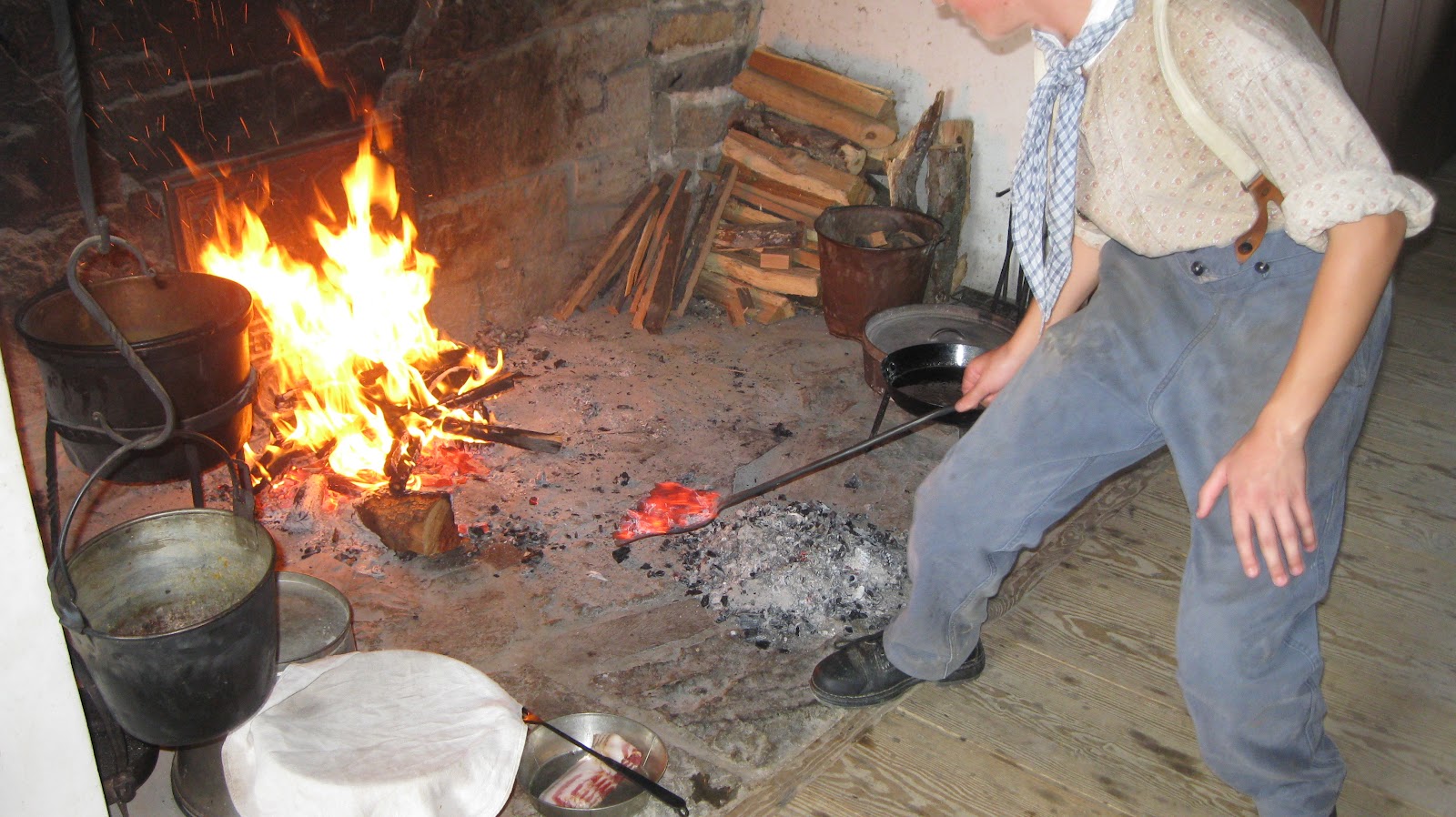
 Heading out to 1820s America next. Menu: Bacon & Eggs pie, blueberry pie.
 Building up the pile of hot coals before placing down the spider skillet. This is for the bacon.
 Blueberry Pie, fresh out of the dutch oven:

Last stop, 1850s America: Mashed potatoes, mashed squash, garden vegetable salad.

They harvested their own potatoes from the farm to get started, and washed them up.
  
Here is the squash they used, from the 1820s garden, called "Turk's Turban."
 Group shot!


Now, I know what you're all thinking. "Poor interpreters! They must've had to clean up after all those children!" I assure you, readers, that these wonderful apprentices even did the dishes!
If you're not drooling yet, here's some final photos of the feast before everyone dug in:

 Until next year!

(If you have a son or daughter between the ages of 12-16, and are interested in joining the John Lewis Society next year, please contact the FCM for details.)


Tuesday, August 7, 2012

Announcing: Yam Day!

Post by Brad, Historical Interpreter:

Today is...
YAM DAY!

We are documenting the progress of our yam experiment on our West African Farm. This is truly an experiment for museum staff because, as far we've found, no one has ever grown yams in the continental US before. This may come as a surprise to many of our readers who conjure up images of mashed yams with marshmallow and cinnamon, but the truth is that  people often mislabel sweet potatoes as yams. Our sweet potatoes, and all potatoes in fact, are originally from South America, but yams are exclusively native to Africa and Asia. Here we are growing the variety of yam most commonly grown in West Africa, classified as dioscorea rotundata, originating in the savanna land of this part of Africa. These yams require LOTS and LOTS of water, warm weather, and a long growing season. This is why they never stuck as a staple crop in the US, though they became popular in the warmer (and more slave-populated) areas in the Caribbean. Here you can follow our little experiment where we will measure the growth, progress, and delicate attention surrounding our miniature yam farm for all to see.     
   
It is hard to overstate the importance of the yam in Igbo culture. It is central in their economy, culture, and (least of all) diet. I would liken them to the Irish and their love of potatoes, but the Igbo connection with the yam goes back many more hundreds of years and is deeply involved in their traditional religion. Often the most respected man in the community is the Di Ji, or Yam King, who possesses the biggest yam barn. He is viewed as exemplifying hard work, productivity, and prosperity, some of the most important traits of an Igbo man. Through hard work and yam farming, most Igbo are at least capable of achieving some level of affluence within their community. This is the primary means for gaining numerous titles, the ultimate goal for any male, which not only brings prestige but allows for varying degrees of participation in community affairs and secret cult organizations.

Below are some photos of our yam experiment. The first Yam Day was actually Tuesday, July 31st. See how fast they grow in one week. These three yams are only a small sampling of the yams we've planted this year. Here's Yam 1. It's the smallest yam.

Yam 2:
 Yam 3, with its twin:

Here's how much they grew in one week.Yam 1-  12.5 inches tall:
Yam 2, 12.5 inches tall:
 Yam 3, the twins, 16 inches tall:

Our own personal (and botanical) Di Ji, standing around 18 inches tall. Stay tuned as we'll delve deeper into the farming tools and techniques, yam culture, food preparation, and more!

Thursday, August 2, 2012

Retting Flax

From Gerry, Historical Interpreter:

There are many different ways of retting. The retting process is rotting of the inside reedy layer of the flax, so that you can free out the fibers.
The Germans use the process of dew-retting, in the fall of the year, when the dew is the heaviest. It is laid out in long thin rows in short grass to collect the nightly dews. It may take several weeks. The problem with this method is that you get mold and mildew on the flax, so the quality is not as good as the Irish linen.
One of the other ways people may be more familiar with is placing it in tubs, but we haven't found 18th century references to this, and it may be a modern (and more environmentally friendly) method. Here on the 1730s-40s Ulster Irish farm, we use our creek.

We started out by getting our flax out of the cow byre, which is Scottish for barn, in our new turf wheelbarrow. We harvested it from our farm in late June. The seeds have already been rippled off, to be sold to the miller and crushed into flaxseed oil.
 The long journey down the hill to the creek.
Find the deepest part of the creek, though no deeper than two feet, and remove any debris from that area. These waters were murky, and smelled bad.
I picked up a medium sized bundle of flax, making sure all the roots are facing in one direction.
 
The flax got gently tossed in to the center of the creek.
 This was repeated until it was all thrown in the water.
 We spread it out in even layers. That way, it wouldn't get crowded, and will rot more evenly.
 
We laid some boards on top to keep the flax submerged. It should be entirely under water. One board should go across the roots, the other across the heads.
 The boards needed some adjustments.
We put rocks on top to weigh the boards down, so they won't float away with the fierce storms of summer. The more flax you have, the more rocks you need. Rocks should be about 3-5lbs.
 Don't fall in!
The flax should ret from three to seven days, depending on the temperature of the water. The hotter the water, the less time it'll need, and the colder the water, the more time it'll need. At the museum, we average about four days.
How will you know it's ready? You pull out a few strands, dry it, and see if it breaks cleanly. When you wrap it around your finger, there should be snaps at every bend. This frees out the fiber, and it should come away in long strands.
When you first start retting your flax in early summer, it's rather pleasant to spend time by the creek. But as the summer wears on, the smell of the rotting flax and the muck in the creek bottom becomes very foul. The smell is like a broken sewer pipe. In fact, the stench is so bad, that, according to folk lore, if you had anything to hide, you'd bury it there because no one would come close. Also, according to folk lore, only young single men were allowed to work at the retting ponds, and this is an age when personal hygiene wasn't well-known, so you can only imagine what a horrendous stench it was.
 A bucolic view.
The next time, we will show you more of the flax processing. We will put the flax through the break, use the scutching knife, and draw it through the hackles.